
As everyone knows, sugar has many harmful properties. Firstly, sugar contains ‘empty’ calories, which is particularly unpleasant for those who are losing weight and struggling to fit all the essential nutrients into their calorie allowance. Secondly, sugar is absorbed instantly, meaning it has a very high glycaemic index, which is very harmful for diabetics, as well as people with reduced insulin sensitivity or metabolic syndrome. It is also known that sugar provokes increased appetite and overeating in overweight people.
Therefore, people have long been using various substances that have a sweet taste but do not have all or some of the harmful properties of sugar. The assumption that replacing sugar with sweeteners leads to weight loss has been experimentally confirmed. Today we will tell you about the types of sweeteners that exist and list the most common modern sweeteners, noting their characteristics.
Let’s start with the terms and basic types of substances related to sweeteners. There are two categories of sugar substitutes.
The first are substances that are more commonly referred to as sugar substitutes. These are usually carbohydrates or substances similar in structure, often found in nature, which have a sweet taste and noticeable calorie content, but are absorbed much more slowly. Thus, they are much safer than sugar, and many of them can even be used by diabetics. However, they do not differ greatly from sugar in terms of sweetness and calorie content.
The second group consists of substances that differ significantly in structure from sugar, have a low calorie content and essentially only provide flavour. They are dozens, hundreds or thousands of times sweeter than sugar and are more commonly referred to as sweeteners.
Let us briefly explain what ‘N times sweeter’ means. It means that in ‘blind’ experiments, people compare different dilutions of sugar solutions and the substance being studied to determine at what concentration the sweetness of the substance being studied is equivalent, to their taste, to the sweetness of the sugar solution. Conclusions about sweetness are made based on concentrations. In reality, this is not always an accurate number, as the sensation can be influenced by factors such as temperature or degree of dilution. Some sweeteners are sweeter when mixed than when used separately, which is why several different sweeteners are often used in beverages at once.
Let’s start with sugar substitutes.
Fructose.
The most well-known sweetener, of natural origin. Formally, it has the same calorie content as sugar, but a much lower glycaemic index (~20). However, fructose is approximately 1.7 times sweeter than sugar, which means it can reduce calorie content by 1.7 times. It is normally absorbed. It is completely safe: just remember that we all eat dozens of grams of fructose every day along with apples or other fruits. It should also be noted that regular sugar breaks down into glucose and fructose inside our bodies, meaning that when we consume 20 g of sugar, we are essentially consuming 10 g of glucose and 10 g of fructose.
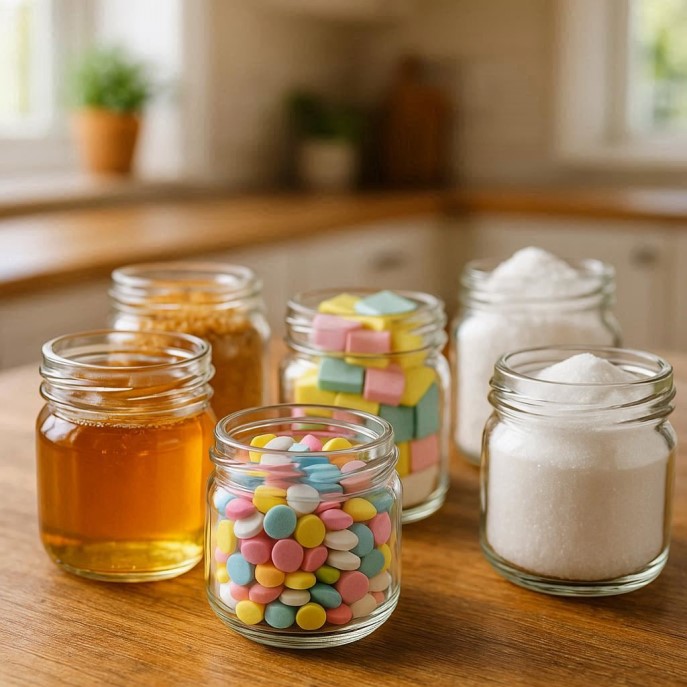
Maltitol, sorbitol, xylitol, erythritol
Polyols are similar to sugars in structure and have a sweet taste. All of them, with the exception of erythritol, are partially absorbed, so they have fewer calories than sugar. Most of them have such a low glycaemic index that they can be used by diabetics without any problems. However, their ‘indigestibility’ has an unpleasant side: undigested substances serve as food for some intestinal bacteria, so large doses (>30-100 g) can lead to bloating, diarrhoea and other problems. Erythritol is almost completely absorbed, but is excreted unchanged by the kidneys.
All sugar substitutes are also good because they do not feed the bacteria that live in the oral cavity and are therefore used in ‘tooth-friendly’ chewing gum. But unlike sweeteners, they do not solve the problem of calorie content.
Sweeteners
Sweeteners are so much sweeter than sugar that regardless of whether the substance is absorbed, such as aspartame, or not absorbed, such as sucralose, its calorie content is negligible when used in normal amounts.
We have listed the most commonly used sweeteners in the table below, indicating some of their characteristics. We have not listed some sweeteners (cyclamate E952, acesulfame E950) because they are usually used in mixtures added to ready-made drinks, and therefore we have no choice as to how much and where to add them.
Saccharin
One of the oldest sweeteners. Discovered at the end of the 19th century. At one time, it was suspected of being carcinogenic (in the 1980s), but all suspicions were removed, and it is still sold worldwide. It can be used in baked goods and hot drinks. The disadvantage is a noticeable ‘metallic’ taste and aftertaste in large doses. Adding cyclamate or acesulfame to saccharin significantly reduces these disadvantages.
Due to its long-standing popularity and low cost, it is still one of the most popular sweeteners in our country. Do not worry if you read another ‘study’ on the Internet about the ‘terrible consequences’ of its use: to date, no experiment has confirmed the danger of adequate doses of saccharin for those who are losing weight (very large doses can affect the intestinal microflora), but the cheapest competitor is an obvious target for attack on the marketing front.
Stevia and steviosides
This sweetener is obtained by extraction from herbs of the Stevia genus. In fact, stevia contains several different chemicals that have a sweet taste:
5–10% stevioside (sweetness relative to sugar: 250–300)
2–4% rebaudioside A – the sweetest (350–450) and least bitter
1–2% rebaudioside C
½–1% dulcoside A.
At one time, stevia was suspected of being mutagenic, but a few years ago, bans on it in Europe and most countries were lifted. However, stevia is still not fully permitted as a food additive in the United States, and only purified rebaudiosides or stevioside are allowed for use as an additive (E960).
Despite the fact that stevia is among the worst modern sweeteners in terms of taste — it has a bitter taste and a strong aftertaste — it is very popular because advertising actively emphasises its natural origin. And although steviol glycosides are completely foreign to humans, for most people who do not understand chemistry, ‘natural’ is synonymous with “safe” and ‘healthy.’ Of course, this is an advertising myth: pale toadstools or the famous ricin poison from castor beans are also natural products, which does not mean they are safe.
Therefore, stevia can now be purchased without any problems, although it is significantly more expensive than saccharin. It can be used in hot drinks and baked goods.
Aspartame
Officially used since 1981, it is characterised by the fact that, unlike most modern sweeteners, which are foreign substances to the body, aspartame is completely metabolised (incorporated into the metabolism). In the body, it breaks down into phenylalanine, aspartic acid and methanol – all three substances are present in large quantities in both our daily food and our bodies.
In particular, compared to sparkling water with aspartame, orange juice contains more methanol, and milk contains more phenylalanine and aspartic acid. Therefore, if someone argues that aspartame is harmful, they will also have to prove that freshly squeezed orange juice is twice as harmful, or that natural yoghurt is three times as harmful. Despite this, marketing wars have not bypassed it, and the usual nonsense sometimes falls on the heads of potential consumers. It should be noted, however, that the maximum permissible dose for aspartame is relatively small, although it exceeds reasonable needs many times over (about a hundred tablets per day).
In terms of taste, aspartame significantly surpasses both stevia and saccharin – it has almost no aftertaste and very little flavour. However, aspartame has a serious disadvantage compared to them – it cannot be heated.
Sucralose
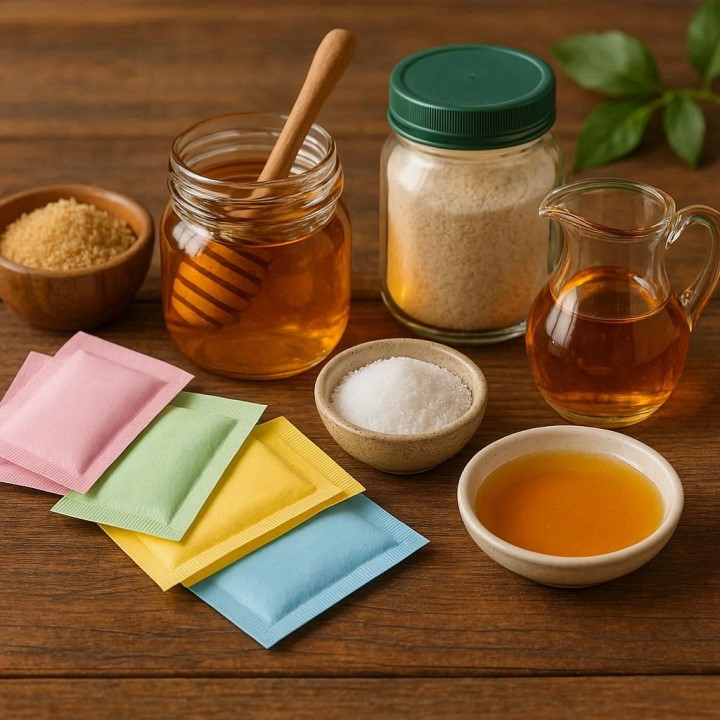
A newer product for us, although it was discovered in 1976 and officially approved in various countries starting in 1991. It is 600 times sweeter than sugar. It has many advantages over the sweeteners described above:
- better taste (practically indistinguishable from sugar, no aftertaste);
- can be heated, used in baking;
- biologically inert (does not react in living organisms, is excreted unchanged);
- it has a huge safety margin (at working doses of tens of milligrams, theoretically, according to animal experiments, safe amounts are not even grams, but somewhere around half a glass of pure sucralose).
So far, there is only one drawback – the price. This may partly explain the fact that while sucralose is actively replacing other types of sweeteners in all countries, in our country, unless you are in Moscow, it is difficult to find it on store shelves. And since we are moving on to newer and newer products, let’s mention one more that has appeared relatively recently:
Neotame
A new sweetener that is 10,000 (!) times sweeter than sugar (to put it in perspective, potassium cyanide is completely safe in such doses). Similar in structure to aspartame, it is metabolised into the same components, but in doses 50 times smaller. It can be heated. Since it actually combines the advantages of all other sweeteners, it may eventually replace them. At the moment, it is permitted in various countries.
So how can we understand which is better?
The most important thing is to understand that all permitted sweeteners are safe in adequate amounts. All sweeteners (especially cheap ones) are the subject of marketing wars (including with sugar producers), and the amount of lies about them significantly exceeds the limits that an ordinary consumer can understand. Choose what you like best, and that will be the best option.
We will just summarise the above with comments on popular myths:
Saccharin is the cheapest, oldest known and most widely used sweetener. It is easy to find everywhere, and if you like the taste, it is the most affordable sugar substitute in every sense.
If you are willing to sacrifice other qualities of the product for the sake of confidence that it is ‘natural,’ choose stevia. But still, understand that naturalness and safety are not related things.
If you want the most researched and definitely safe sweetener, choose aspartame. All the substances it breaks down into in the body are found in food and in the body itself, even if you have never eaten any aspartame. However, aspartame is not suitable for baking.
If the main quality of a sweetener that is important to you is that it tastes like sugar, and maximum theoretical safety is important, choose sucralose. It is more expensive, but it may be worth the money for you. Give it a try.
That’s all you need to know about sweeteners. And the most important thing to know is that sweeteners help overweight people lose weight, and if you can’t give up sweet flavours, then sweeteners are the right choice for you.
